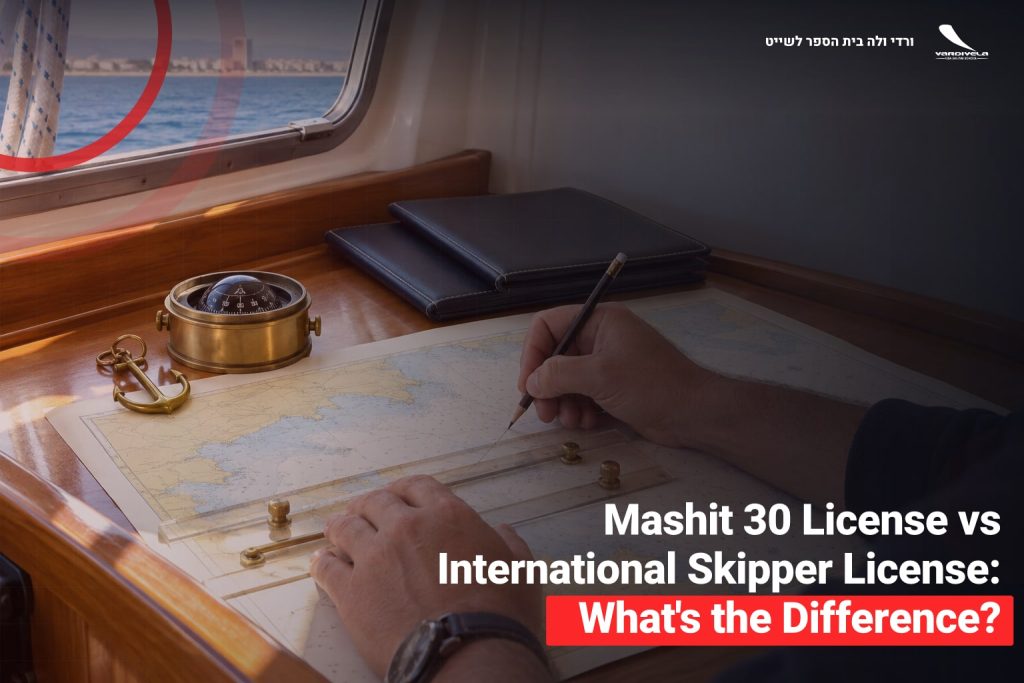
Mashit 30 license and an international skipper license both let you take a boat out on your own, but they are not interchangeable, and confusing them can leave you unable to sail the vessel you actually planned to operate.
A Mashit 30 license is an Israeli local qualification, generally covering motor or sail vessels up to about 30 feet within a defined coastal range near Israel's shore.
An international skipper license, such as the ISSA Boat Master certification taught at Vardi Vela Cyprus ISSA Sailing School, is built on the ICC (International Certificate of Competence) standard, which is recognized in a wide range of countries, most of them in Europe, and accepted in practice by many yacht rental companies and marinas around the Mediterranean, the Caribbean and Southeast Asia.
If your plans include an inshore skipper course, an offshore skipper course, or eventually a master of yacht sail or master of yacht power qualification, the international route generally opens more doors than a Mashit 30 license alone.
Reach out to Vardi Vela Cyprus ISSA Sailing School to see which path fits the sailing you actually want to do.
What Is a Mashit 30 License?
A Mashit 30 license is a certification issued in Israel that authorizes you to skipper motor or sailing vessels up to approximately 30 feet, typically within Israeli territorial waters and a limited distance from shore, depending on the specific endorsement attached to the license.
It is a practical starting point for people who want to operate a small boat locally, rent a boat along the Israeli coast, or take a family out for a day on the water without needing a full international qualification.
The Mashit 30 license was designed with local conditions in mind, so its training and its recognition stay largely within Israel's own regulatory framework.
That is useful if all your sailing happens close to home, but it becomes a limiting factor the moment you want to charter a yacht abroad, join a flotilla in another country, or work as a skipper outside Israeli waters.
How Does an International Skipper License Compare to a Local Certification?
An international skipper license, such as the ones issued through ISSA (International Sailing School Association), follows the ICC standard rather than a single country's local rules. Vardi Vela Cyprus ISSA Sailing School has trained skippers on this standard since 2008, and the school's founder is closely involved in ISSA's international standard-setting work, which helps shape guidelines for small craft certification.
According to a senior sailing instructor, the biggest gap students underestimate is not boat handling itself but how differently local rules of the road, buoyage and radio procedure can vary once you leave your home waters, regardless of which license you are holding.
That is exactly the gap an international course is built to close, since it trains you against a shared international framework rather than a single country's coastal rules.
In practice, this means a Boat Master license earned in Cyprus is recognized well beyond the country where you trained, while a Mashit 30 license was never designed to travel with you.
If you plan to rent a boat abroad, join a sailing club membership program in Larnaca, or work toward an ISSA PRO commercial skipper license later on, the international certification is the one that keeps those doors open.
Which Vessel Types and Sailing Areas Does Each License Cover?
The Mashit 30 license is scoped to smaller vessels and a defined coastal area, which is enough for local day sailing but not for longer passages or larger yachts.
The ISSA framework, by contrast, is built around a ladder of certifications matched to vessel size and distance from shore.
An inshore skipper course covers sailing or power vessels within sight of land and in relatively sheltered conditions, while an offshore skipper course extends that to open water passages, night sailing and greater self-sufficiency on board.
Above those sit the master of yacht sail and master of yacht power certifications, aimed at larger vessels and more demanding conditions, and the ISSA PRO commercial skipper license, which is built for people who want to skipper professionally rather than recreationally.
Because the ICC standard defines vessel categories consistently across the countries that recognize it, a license earned in Cyprus tells a marina or a yacht rental company abroad exactly what vessel size and sea conditions you are qualified for, in a way a Mashit 30 license was never built to communicate outside Israel.
How Long Does Each Course Take and What Is Required to Get Certified?
Course length depends on the certification level and the format you choose.
Group courses at Vardi Vela Cyprus ISSA Sailing School require a minimum number of participants, while a private course can be arranged for a smaller group, which shortens or reshapes the schedule around your own availability.
Whichever format you choose, passing the final exam is a mandatory condition for receiving the certificate, both for the practical handling assessment and for the theory covering navigation, safety and radio procedure.
A VHF/SRC marine radio course is often taken alongside a skipper course, since radio competence is part of what an international license is expected to demonstrate on the water.
Students who plan to keep sailing after certification often continue through a sailing club membership in Larnaca to keep building sea time, or look into yacht rental in Cyprus as a way to practice on different vessel types before committing to a bigger purchase.
The table below summarizes the main practical differences between the two paths.
| Feature | Mashit 30 License | International Skipper License (ISSA) |
|---|---|---|
| Governing standard | Israeli local regulation | ICC (International Certificate of Competence) |
| Typical vessel size | Up to about 30 feet | Ranges by level, up to larger yachts under Master of Yacht certifications |
| Area of validity | Israeli coastal waters | Recognized across many countries, mostly in Europe, and accepted by many yacht rental firms and marinas abroad |
| Best suited for | Local day sailing near home | Chartering abroad, flotillas, professional or extended sailing |
| Path to commercial work | Not applicable | Can lead toward the ISSA PRO commercial skipper license |
Frequently Asked Questions
A few practical questions come up often once people understand the basic difference between the two licenses.
Can you upgrade from a Mashit 30 license to an international license later?
Yes, many people start locally and later enroll in an ISSA course once they decide to sail abroad or move to larger vessels.
Existing boat handling experience is useful preparation, but you still need to complete the ISSA training and pass its exam, since the two certifications are built on different standards.
Does an international skipper license require a medical certificate?
Requirements can vary by course level and destination, so this is worth confirming directly with the school before enrolling rather than assuming it matches local Israeli practice.
Can you take an international skipper course without prior sailing experience?
Inshore-level courses are generally designed for beginners and build the required skills from the ground up, while higher levels such as offshore or master of yacht courses typically expect prior sea time or a lower-level certification first.
What happens if you fail the exam on your first attempt?
Passing the exam is a mandatory condition for certification, so a failed attempt means the certificate is not issued until the requirements are met.
Specific retake arrangements depend on the course and should be confirmed with the school directly.
Mashit 30 License or International Certification: How Vardi Vela Cyprus ISSA Sailing School Can Help
Choosing between a Mashit 30 license and an international skipper license really comes down to where and how you plan to sail.
If everything you do stays close to home on a smaller vessel, the local license does the job.
If you want a certification that travels with you, whether that means chartering abroad, joining a sailing club membership in Larnaca to keep building sea time, or eventually working toward an ISSA PRO commercial skipper license, the ICC-based route is the one built for that.
Vardi Vela Cyprus ISSA Sailing School has been training skippers on this international standard since 2008, with courses ranging from inshore and offshore skipper training to master of yacht sail and master of yacht power certifications, alongside services like yacht rental in Cyprus and yacht buying and selling consultancy for people planning their next step after certification.
If you are still weighing a Mashit 30 license against an international option, get in touch with Vardi Vela Cyprus ISSA Sailing School and talk through which certification actually matches your sailing plans.